Blog

Career Pivoting: Reposition Yourself Without Starting Over

For a long time, careers followed a predictable path. You chose a direction early, built experience within that lane, and progressed upward over time. Changing industries or roles was seen as risky, even discouraged. That’s no longer the reality.

Today, career pivots are common and even expected. Professionals are moving into new industries and roles, and redefining growth. Even though pivoting is now widely accepted, the process can still feel uncertain, and that leads to new questions.

Because the question isn’t just “What do I want to do next?”
It’s “How do I get there without starting over?

Career Pivots Are No Longer the Exception — They’re the Norm

If a career pivot feels like a big decision, it’s worth understanding just how common it has become. The average professional now changes jobs approximately every four years, and those moves increasingly involve shifts in role, function, or industry, not just changes of company. Career mobility is no longer a disruption, but has become part of the modern professional lifecycle.

For mid-career professionals, this trend is even more significant. A growing percentage of career changes happen later in professional life. Many individuals are pivoting well into their 30s, 40s, and beyond. Notably, those who make intentional career shifts often report greater long-term satisfaction after making the change.

At the same time, broader workplace trends are accelerating this shift:

  • Rapid technological advancement is redefining roles.
  • Skills are becoming more valuable than tenure alone.
  • Career paths are becoming less linear and more flexible.
  • Professionals are placing greater emphasis on purpose and alignment.

In other words, pivoting is a strategic response to a changing world of work.

You’re Not Starting From Scratch
Even If It Feels That Way

One of the biggest misconceptions about career changes is that you need to rebuild from zero. What you’ve already built still holds value; it just needs to be reframed. Skills like leadership, communication, problem-solving, and project management aren’t tied to a single role or industry. They carry across functions and environments.

The challenge isn’t a lack of experience but of translation. When your experience is presented in a way that aligns with your target role, what once felt unrelated can quickly become relevant.

Shifting the Narrative of Your Experience

When pivoting, your resume needs to do something different from what it would in a traditional career progression. Instead of reinforcing a linear path, it needs to support a shift in direction. That often means rethinking how your experience is presented — not rewriting your history, but reshaping the story it tells. What becomes important isn’t just what you’ve done, but how it connects to where you’re going.

That may involve:

  • Highlighting transferable skills more prominently.
  • Reframing achievements to align with your target role.
  • Adjusting language to reflect a new direction.

Many professionals struggle here because they present their experience exactly as it happened, rather than as it needs to be understood, and in doing so, they make it harder for employers to see the connection.

Positioning Yourself for the Role You Want

When hiring managers review a candidate who is pivoting, they’re looking for signals. Signals that the move is intentional, the candidate understands the role, and the transition will be successful.

Your materials should reinforce those signals clearly and consistently. Your headline shouldn’t just reflect your past; it should point toward your future. Your summary shouldn’t just explain what you’ve done; it should connect your experience to where you’re headed. Clarity builds confidence, and confidence builds credibility.

Bridging the Gap Without Overcomplicating It

Sometimes, a pivot benefits from additional support. Small, strategic steps can make a meaningful difference. A certification. A short-term project. Freelance or contract work. Even self-directed learning can demonstrate commitment to your new path.

These additions reinforce your existing experience, and show that your pivot isn’t just an idea but something you’re actively working toward.

The Rise of Skills-Based Hiring

Another reason career pivots are becoming more accessible is the shift toward skills-based hiring. More employers are prioritizing what candidates can do over where they’ve been. Demonstrated abilities, not just job titles, are carrying more weight in hiring decisions.

For professionals considering a pivot, this is a significant advantage. It creates space to reposition your experience and highlight capability over chronology. But it also raises the bar for how clearly those skills are communicated. If your transferable skills aren’t visible, they don’t exist from a hiring perspective.

Making It Solid

Career transitions are as much about mindset as they are about strategy. If your messaging feels uncertain, it creates hesitation. But when your positioning is clear and intentional, it signals readiness. You’re presenting a case, not asking for a chance.

This shift toward career mobility is becoming the standard. And professionals who can confidently reposition themselves are often the ones who move forward more effectively. You don’t need to have all the answers. Confidence comes from understanding how your experience applies, and communicating that clearly.

A Strategic Approach to Reinvention

Career pivots are opportunities and not setbacks. They’re a chance to refine your direction, clarify your strengths, and reposition your experience to support long-term growth, and that only works when your materials reflect the shift you’re trying to make.

Are you thinking about making a career move? Career transitions don’t require starting over, but they do require clarity and strategy. Your experience isn’t just something to document, it’s something to reframe. At Craft Career Studio, we help professionals reframe their experience to support new directions with confidence. We approach each resume with intention, helping align your past experience with your next direction.

A successful pivot is about using your past strategically to build what comes next. Let’s craft a narrative that moves you forward. Connect with us today by calling 908-472-1461 or by emailing Info@craftcareerstudio.com and let’s get started!

Is a Resume Writing Service Worth It in 2026? 

What You’re Actually Investing In

At some point in your job search, the question arises: Should I hire a professional resume writer, or just do this myself? It’s a fair question, and an important one.

With free templates, AI tools, and endless online advice, it may seem like it has never been easier to create a resume on your own. At the same time, the hiring process has become more complex, more competitive, and more selective than ever.

If you’ve spent time applying to roles without hearing back, revising your resume repeatedly, or second-guessing how to present your experience, the question starts to shift. It becomes no longer about convenience and all about results. 

What You’re Really Paying For

When people consider a resume writing service, they often focus on the final document, but the real value goes deeper than that. A strong resume surpasses good writing; it’s intentionally structured, strategically aligned, and designed to communicate your value quickly and clearly.

What you’re investing in is perspective. An objective, experienced view of your career, one that can identify what matters most, remove what doesn’t, and shape your experience into something that aligns with your goals.

At Craft Career Studio, each resume is built with clear intent and a focus on helping you move forward.

Why Strong Resumes Still Get Overlooked

One of the most frustrating parts of the job search is knowing you’re qualified but not getting responses. It’s easy to assume the issue is competition. And while competition does play a role, it’s not always the deciding factor.

Often, the issue is communication. If your resume doesn’t clearly connect your experience to the role you’re applying for, it creates friction. Recruiters may not immediately see the alignment, and when time is limited, they move on.

This doesn’t mean your experience isn’t valuable, but it isn’t being interpreted the way it needs to be. A professionally crafted resume reduces that friction. It makes your value easier to recognize, faster.

The Hidden Cost of Doing It Yourself

On the surface, writing your own resume feels like the more cost-effective option, but there are hidden costs that aren’t always obvious. Time is one of them.

Writing a strong resume isn’t a quick task. It requires reflection, editing, research, and multiple revisions. For many professionals, it becomes a frustrating and time-consuming process that still doesn’t produce the desired results and leaves uncertainty.

There’s an opportunity cost. If your resume isn’t generating interviews, your job search can extend longer than expected. That delay can impact income, momentum, and overall confidence.

There’s also the challenge of objectivity. It’s difficult to evaluate your own experience from an external perspective. You may undersell key achievements or focus on details that don’t align with your target role.
These aren’t obvious costs, but they add up.

“Good” vs “Effective”

Many resumes are good: well-written, visually clean, and professionally presented. But being “good” isn’t always enough. An effective resume does more than look polished; it performs. An effective resume aligns with the roles you’re targeting. It communicates value quickly. It removes ambiguity and makes it easy for a recruiter to say, “Yes, this person fits.”

That distinction is important. In a competitive job market, the difference between being considered and being overlooked often comes down to how clearly you communicate your value.

AI Tools vs Professional Resume Writers

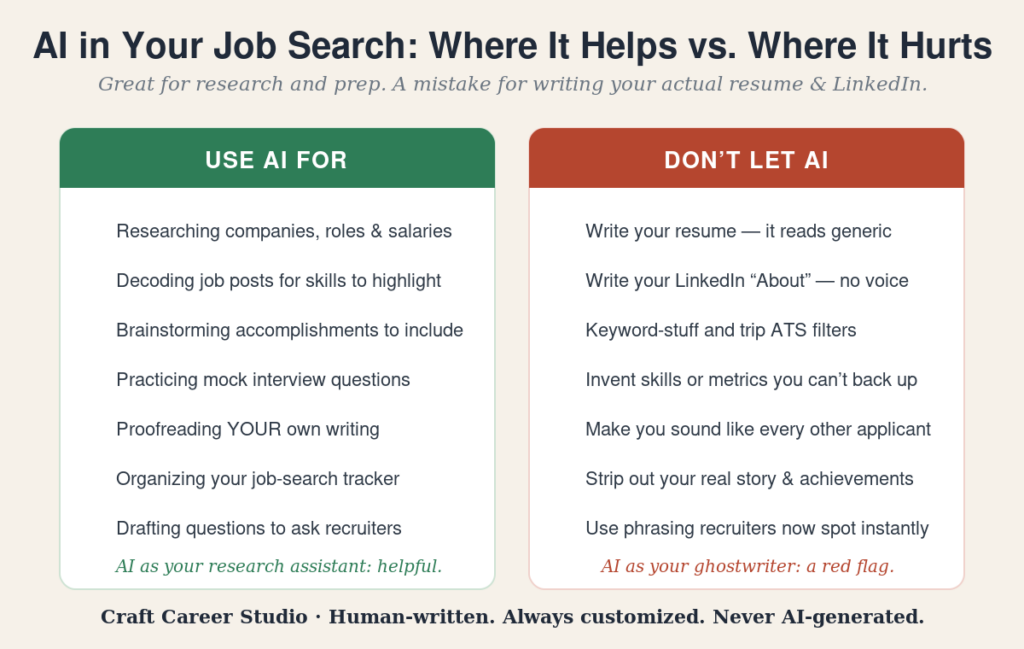
AI has changed the world of resume writing, and it’s worth addressing directly. Tools can now generate resumes in minutes. They can suggest keywords, format content, and even tailor documents to specific roles with the right prompts. But speed isn’t the same as strategy.
AI-generated resumes often:

  • Sound generic or repetitive.
  • Miss nuance and personalization.
  • Miss subtle but important positioning opportunities.
  • Overuse keywords without context.

AI tools can be a helpful starting point. But they rarely produce a final product that stands out in a competitive hiring process. A human writer with experience brings something different. A human can understand tone, context, and narrative. They can interpret your experience, identify your strengths, and shape your story in a way that resonates with both systems and people, and that’s the difference between a resume that exists and one that performs.

Who Benefits Most from a Resume Writing Service?

Not every job seeker needs professional help, but for many mid-level professionals, it can be a significant advantage.

You’re likely to benefit if:

  • You’re applying to roles but not getting interviews.
  • You’re transitioning into a new role or industry.
  • You haven’t updated your resume in several years.
  • You’re unsure how to position your experience.
  • You want to compete more effectively in a crowded market.

At this stage of your career, the stakes are higher. Roles are more competitive, expectations are clearer, and small differences in presentation can have a big impact.

The Confidence Factor

There’s another benefit that often gets overlooked: confidence.

When you know your resume is strong, it changes how you approach your job search. You apply more strategically, present yourself more clearly, and engage with opportunities more confidently. That shift matters. Job searching is about positioning yourself as the right candidate as much as it is about submitting applications. Confidence supports better outcomes

So, Is It Worth It?

For many professionals, the answer is yes, but not for the reasons they initially expect. It’s not about having a nicer-looking document; it’s about having a resume that works. One that accurately reflects your experience, aligns with your goals, and performs in a modern hiring environment. In a competitive job market, how you present your experience matters just as much as the experience itself.

We call ourselves Craft Career Studio because we don’t just write resumes; we craft them. With a focus on clarity, strategy, and human-centered messaging, our goal is to help you be seen, recognized, and move forward in your career with confidence. Connect with us today by calling 908-472-1461 or by emailing Info@CraftCareerStudio.com, and let’s get started!

LinkedIn Is Your Second Resume 

(It Might Be More Important Than the First)

If your resume gets you through the door, your LinkedIn profile often determines whether that door opens at all. Today, recruiters don’t rely solely on job applications. They actively search for candidates. And when they find you, your LinkedIn profile becomes your first impression, long before you ever submit a resume.

For many job seekers, that shift has gone unnoticed. They update their resume when they’re job searching, but their LinkedIn profile remains static: outdated, underdeveloped, or missing entirely. And in a hiring world that increasingly prioritizes visibility and searchability, that’s a missed opportunity.

We see it all the time at Craft Career Studio: highly qualified professionals who aren’t being discovered simply because their LinkedIn presence isn’t working for them. The good news is that, with the right strategy, LinkedIn can become one of the most powerful tools in your job search.

The Shift to Search-Based Hiring

Recruitment has evolved. Instead of waiting for candidates to apply, employers now take a more proactive approach. Recruiters use LinkedIn as a search engine, filtering candidates by job titles, skills, experience, and keywords. In many cases, your profile is being evaluated before you even know an opportunity exists. That means your LinkedIn presence isn’t just a supplement to your resume; it’s a core part of your career strategy.

If your profile isn’t optimized with relevant keywords or aligned with your target roles, you may never appear in those searches. And you can’t be considered if your profile doesn’t show up.  Visibility is about structure, not luck.

Your Headline
The First (and Most Overlooked) Opportunity

Your headline is one of the most important and most underutilized sections of your LinkedIn profile. It follows your name everywhere on the platform. It shows up in search results, connection requests, and comments. And in many cases, it determines whether someone clicks on your profile at all. Yet most professionals treat it as a placeholder. They list their current job title and leave it at that.

Your headline can do so much more. A strong headline communicates not just what you do, but the value you bring. It adds context, clarity, and direction. It helps both recruiters and hiring managers understand where you fit.

Instead of simply stating your role, your headline should position you.

Not just:

“Project Manager”

But something closer to:

“Project Manager | Delivering Cross-Functional Projects That Improve Efficiency and Drive Results.”

It’s a small shift, but it changes how you’re perceived.

The About Section
Strategy Meets Story

If your headline gets someone to click, your About section is what keeps them reading. This is where many LinkedIn profiles fall short. Too often, it’s either left blank, written in a rushed tone, or copied directly from a resume summary.

But this section is an opportunity to do something your resume can’t fully accomplish: tell your story.

A strong About section should be deliberate. It should introduce you, highlight your strengths, and provide a clear sense of direction. That doesn’t mean writing a long, detailed autobiography. It means being selective and strategic.

Think of it as a narrative with three parts:

  • A clear opening that defines who you are professionally.
  • A middle that highlights your key strengths and achievements.
  • A closing that reflects where you’re headed.

This is also where tone matters. While your resume tends to be more formal and structured, your LinkedIn profile can be slightly more conversational: still professional, but more human. That balance is what makes it engaging.

Experience That Shows Impact 

(Not Just Activity)

One of the most common mistakes on LinkedIn is treating the Experience section like a job description. Listing responsibilities might explain what your role involved, but it doesn’t communicate how well you performed. And that’s what employers care about. Your experience should highlight the impact. Instead of focusing on what you were responsible for, focus on what you achieved. What changed because of your work? What results did you contribute to? How did you add value?

This doesn’t mean every bullet point needs to include a number — but where possible, measurable outcomes strengthen your credibility. Even small shifts in language can make a difference. “Managed team operations” becomes: Led daily operations for a team, improving workflow efficiency and consistency The goal is clarity, not complexity.

Skills, Keywords, and Search Visibility

Spoiler alert: LinkedIn isn’t just a networking platform; it’s a search engine.

And like any search engine, it relies on keywords. The words you use throughout your profile, in your headline, About section, and experience, play a major role in whether you appear in recruiter searches. This is where alignment becomes important. If you’re targeting a specific role, your profile should reflect the language commonly used in that role’s job descriptions. This includes skills, tools, and core competencies.

Your Skills section also plays a supporting role here. Adding relevant skills and keeping current helps reinforce your profile’s positioning. But this isn’t about keyword stuffing. It’s about consistency. When your messaging is aligned across your entire profile, it becomes easier for both algorithms and people to understand what you bring to the table.

Activity
The Valuable Layer Most People Ignore

A complete profile is essential, but activity adds another dimension. You don’t need to become a full-time content creator to benefit from LinkedIn engagement. But showing up occasionally can increase your visibility in meaningful ways. This could be as simple as:

  • Sharing an insight or perspective
  • Commenting on industry-related posts
  • Engaging with content from your network

These small actions signal that you’re active and engaged in your field. They also make your profile feel current. In a platform where visibility matters, even light engagement can make a difference.

Consistency Between Resume and LinkedIn

Your resume and LinkedIn profile should support each other, not duplicate each other. Consistency in messaging is important. Your roles, timelines, and core achievements should align; however, your LinkedIn profile allows for a bit more flexibility. It can be more extensive. Slightly more conversational. More reflective of your personality.

Think of your resume as a focused, targeted document for a specific role. Your LinkedIn profile is your broader professional presence, always working in the background. Together, they create a more complete picture.

A Strong LinkedIn Profile Counts

The hiring process no longer follows a linear path. Candidates don’t just apply and wait. Recruiters don’t just post and review. The process is dynamic, ongoing, and often happens behind the scenes. That’s why LinkedIn has become so important.

It allows you to:

  • Be discovered for roles you didn’t apply for.
  • Build credibility before conversations begin.
  • Reinforce your experience and positioning.
  • Stay visible within your industry.

In many cases, it’s not just supporting your job search; it’s driving it.

Crafting a Profile That Works for You

At Craft Career Studio, our approach to LinkedIn is the same as our approach to resumes: we proceed intentionally, with a clear strategy. We don’t just update profiles. We position them.

We consider how recruiters search, how hiring managers evaluate, and how professionals can present themselves clearly and confidently in a competitive space. Because in today’s market, being qualified isn’t enough. You need to be visible. You need to be understood. And you need to be positioned in a way that makes opportunities easier to find you.

Is your LinkedIn profile working for you, or just sitting there? If your profile isn’t attracting recruiter attention or aligning with your career goals, a few strategic changes can make a significant difference. Craft Career Studio helps professionals transform their LinkedIn presence into a powerful, search-optimized extension of their resume. Get found. Get noticed. Get closer to your next opportunity. Connect with us today by calling 908-472-1461 or by emailing info@CraftCareerStudio.com, and let’s get started!

The Resume Is Evolving

Stand Out in a Filter-First Hiring World

For years, job seekers have heard the same advice: update your resume, apply consistently, and opportunities will follow. But today’s hiring process tells a different story. The way resumes are evaluated has changed, and much of the advice circulating hasn’t caught up. What worked a decade ago is no longer enough in a system driven by speed, technology, and increasing competition.

The modern resume has evolved from a static document to a strategic tool that must perform in a filter-first hiring environment, and understanding this shift is the first step toward standing out.

The Rise of the Filter-First Hiring Process

Before your resume reaches a hiring manager, it often passes through an Applicant Tracking System (ATS). These systems are designed to scan and organize applications based on relevance to a role. This means your resume is being evaluated long before a human ever reads it.

And while that may sound technical, the takeaway is simple: clarity and alignment matter more than ever. Resumes that reflect the language, structure, and priorities of a job description are far more likely to move forward. Even if the candidate is highly qualified, their resume can be overlooked if it doesn’t follow this new factor. It’s vital to understand how hiring now works.

From Responsibilities to Results

Another major shift is how experience is interpreted. In the past, listing responsibilities was often enough. Today, it’s not. Hiring managers want to understand impact.

Recruiters are asking:

  • What did you contribute?
  • What changed because of your work?
  • How do you compare to other candidates?

The most effective resumes focus less on duties and more on outcomes. Instead of simply stating what you were responsible for, your resume should reflect what you achieved and how that work created value. This shift may seem subtle, but it has a significant impact on how your experience is perceived.

Clarity Is the New Competitive Advantage

In a high-volume hiring environment, clarity wins. Recruiters don’t have time to interpret vague descriptions or dense paragraphs. They scan quickly, looking for signals of relevance, capability, and impact. A resume that is easy to read and easy to understand has a clear advantage.

That means:

  • Structured sections
  • Concise, intentional language
  • Logical flow
  • Clear alignment with the role

It’s about making what you say easier to recognize, rather than saying more. Dense blocks of text, vague job descriptions, and generic responsibilities make it challenging for recruiters to see your value. Concise, results-driven statements make your impact immediately visible.

For example, instead of:

Responsible for managing a team and spearheading projects that impacted several departments.

A stronger, results-focused approach would be:

Led a team of 8 on cross-functional projects, improving delivery timelines by 25%.
This shift from responsibility to results is critical.

The Mid-Career Complexity

For mid-level professionals, resume writing becomes more nuanced. You have enough experience to demonstrate depth, but too much to include everything. Deciding what to emphasize (and what to leave out) becomes part of the strategy.

This is where many resumes lose focus. Instead of presenting a clear direction, they become a comprehensive record of everything the candidate has done, but hiring managers aren’t looking for your entire history. They’re looking for relevance.

A strong resume prioritizes what matters most for your next step, not just what reflects your past.

Simple Still Works

With so many tools and templates available, it’s easy to assume that a more complex design will make your resume stand out. In reality, simplicity is often more effective. Clean formatting, clear headings, and consistent structure help both systems and humans process your information quickly.

Visual complexity, such as including unnecessary graphics, can sometimes work against you,  especially when it interferes with readability or ATS compatibility. Simple isn’t basic; it means you’re intentional. A well-structured resume makes your content shine without distraction.

Where Resume Writing Is Headed

Resumes are not disappearing; they are becoming more strategic. As hiring becomes more competitive, the difference between candidates often comes down to how effectively their experience is presented. 

The future belongs to job seekers who understand how to align their experience with job descriptions, communicate their impact clearly, and position themselves as the solution employers are looking for.

Your Career, Handcrafted

There is no one-size-fits-all resume with Career Craft Studio. We believe in thoughtful, human-centered career marketing, resumes crafted with intention, optimized for visibility, and designed to achieve results. Because your career deserves more than a template. It deserves to be handcrafted. 

If you’re not sure whether your resume is optimized for today’s hiring systems or if it’s truly reflecting your value, it may be time for a second look. At Craft Career Studio, the resumes we work on are built to perform in a filter-first world while still connecting with real decision-makers. Let’s craft something that works as hard as you do. Connect with us today by calling 908-472-1461 or by emailing Info@CraftCareerStudio.com, and let’s get started!