

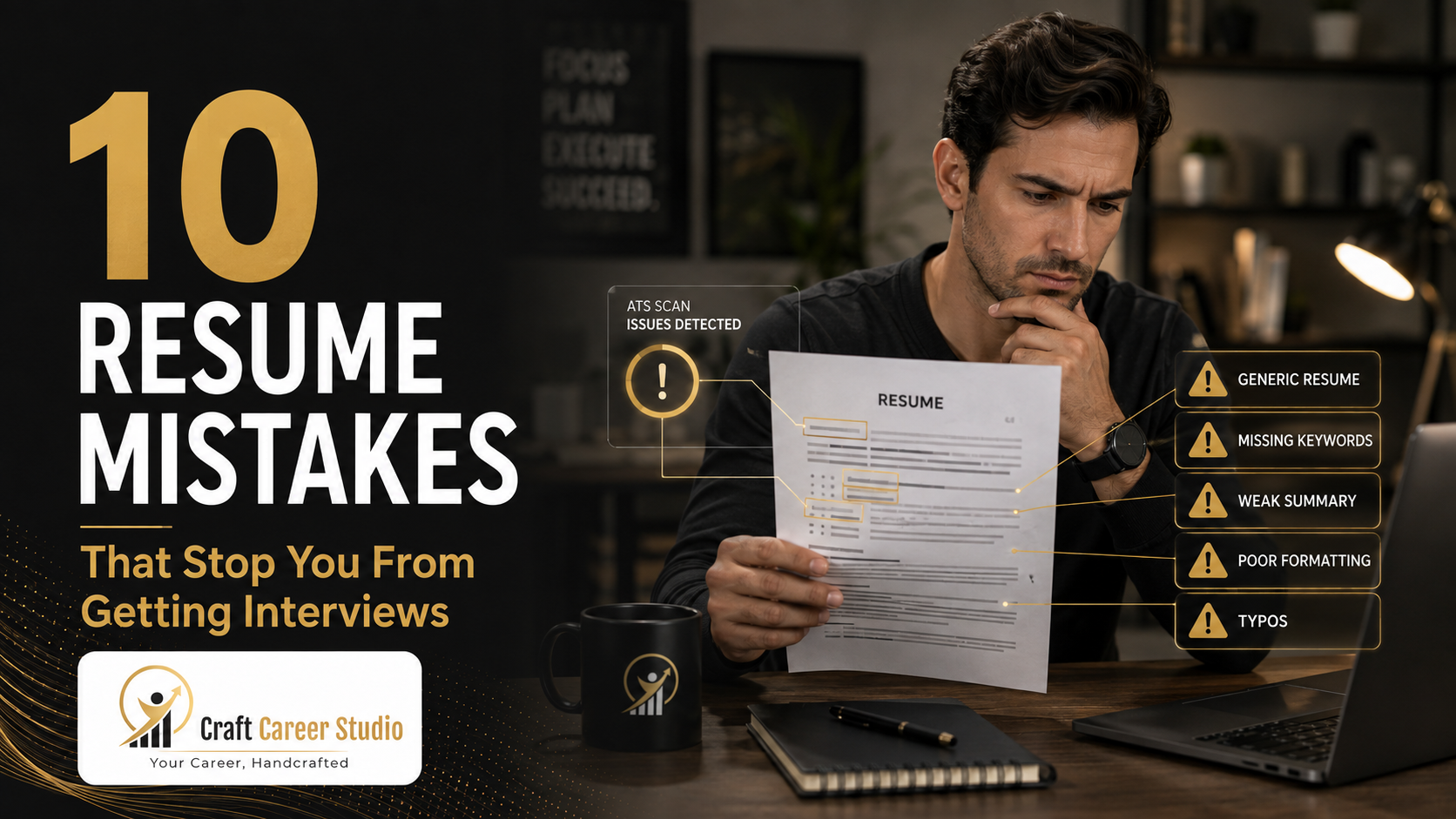
A good resume should open doors rather than close them. However, many qualified candidates struggle to secure interviews because their resumes do not communicate their experience, skills, and professional value effectively.
Modern hiring processes often involve both Applicant Tracking Systems and human recruiters. Before your application reaches a hiring manager, it may be screened for relevant keywords, skills, qualifications, formatting, and alignment with the position.
If you have applied for several jobs without receiving interview invitations, the problem may not be your experience. Your resume could be preventing employers from recognizing your qualifications.
Getting professional Help With Resume Writing can identify weaknesses in your application, but understanding the most common mistakes is an important first step. The following Resume Errors can reduce your visibility and make it more difficult to compete for suitable opportunities.
Why Your Resume Matters in Today’s Hiring Process
Employers may receive hundreds of applications for a single position. As a result, recruiters need an efficient way to identify candidates whose experience matches the role.
Applicant Tracking Systems help organize and evaluate applications before a recruiter conducts a more detailed review. If your resume lacks important keywords or uses formatting that the software cannot interpret correctly, your application may be ranked lower.
Once your resume reaches a recruiter, it should make your qualifications easy to understand.
A strong resume quickly communicates:
- Your professional level
- Your relevant experience
- Your most valuable skills
- Your measurable achievements
- Your qualifications and certifications
- The value you could bring to the employer
Fortunately, many resume problems can be corrected once you know what to look for.
10 Common Resume Mistakes to Avoid
1. Using the Same Resume for Every Job
Sending the same general resume to every employer is one of the most common mistakes job seekers make.
Each position has different requirements, priorities, and preferred qualifications. One employer may prioritize leadership experience, while another may focus on technical skills, certifications, or client management.
Tailor your resume by reviewing the job description and identifying:
- Important skills
- Required qualifications
- Relevant job titles
- Industry terminology
- Repeated keywords
- Primary responsibilities
Adjust your professional summary, skills, and selected achievements accordingly. You do not need to rewrite the entire resume, but the most relevant information should be easy for the employer to find.
2. Listing Responsibilities Instead of Achievements
Recruiters generally understand the basic responsibilities associated with common job titles. What they need to know is how effectively you performed those responsibilities.
A duty focused statement might say:
“Responsible for managing customer accounts.”
An achievement-focused version could say:
“Managed a portfolio of 40 customer accounts and improved annual client retention by 18%.”
The second example provides evidence of scale and impact.
When reviewing Resume Examples, look for statements that include measurable outcomes such as:
- Revenue generated
- Costs reduced
- Time saved
- Productivity increased
- Customers retained
- Projects completed
- Employees trained
- Processes improved
- Targets exceeded
Use accurate numbers, percentages, timeframes, and results whenever possible.
3. Ignoring ATS Optimization
Some resumes are difficult for Applicant Tracking Systems to interpret because they lack relevant keywords or contain complicated design elements.
An effective ATS Resume should use clear formatting and natural language that reflects the requirements of the target position.
Common ATS problems include:
- Missing industry keywords
- Unusual job titles without clarification
- Text placed inside images
- Complicated tables or columns
- Important information inside headers or footers
- Decorative section headings
- Excessive graphics and icons
Use standard headings such as Professional Summary, Work Experience, Skills, Education, and Certifications. Keywords should appear naturally and accurately rather than being added repeatedly without context.
4. Writing a Weak Professional Summary
Your professional summary is one of the first sections a recruiter may read. Generic statements such as “hardworking professional seeking a challenging opportunity” provide little meaningful information.
A strong summary should briefly explain:
- Your professional identity
- Your level of experience
- Your primary areas of expertise
- One or two notable strengths
- The type of value you offer
For example:
“Operations manager with eight years of experience improving workflow efficiency, leading cross-functional teams, and reducing operating costs in fast-paced manufacturing environments.”
This statement gives employers a much clearer understanding of the candidate’s background and direction.
5. Including Too Much Irrelevant Information
Adding more information does not automatically make a resume stronger. Excessive detail can hide your most valuable qualifications and make the document difficult to review.
Information that may need to be removed or reduced includes:
- Outdated positions unrelated to your current goals
- Detailed descriptions of basic duties
- Personal information that employers do not require
- Irrelevant hobbies
- Repetitive skills
- Old technologies no longer used in your industry
- References or the phrase “references available upon request”
Every section should help answer one question: Why is this candidate suitable for the position?
Prioritize recent, relevant, and results-focused information.
6. Using Poor Formatting or Distracting Design
Your resume should look professional without distracting employers from the content.
A clean Resume Format normally includes:
- Clear section headings
- Consistent spacing
- Professional fonts
- Short bullet points
- Balanced white space
- Consistent dates and job titles
- A logical order of information
Avoid using too many colors, decorative fonts, text boxes, graphics, or complex layouts. These elements can reduce readability and may cause problems when an ATS attempts to process the document.
Good formatting helps recruiters locate important information quickly.
7. Failing to Highlight Relevant Skills
Employers often look for specific technical abilities, industry knowledge, software experience, certifications, and interpersonal skills.
If your strongest qualifications are buried inside long paragraphs, recruiters may overlook them.
Include a dedicated skills section containing abilities relevant to the target position. You should also demonstrate those skills through your work experience.
For example, instead of simply listing “project management,” show how you used that skill:
“Coordinated a six-month system implementation across four departments and completed the project two weeks ahead of schedule.”
This approach supports your claimed skills with practical evidence.
8. Leaving Grammar and Spelling Mistakes
Spelling errors, inconsistent punctuation, and awkward sentences can weaken the professional impression created by your resume.
These mistakes may suggest poor attention to detail, especially when communication is important to the position.
Before submitting your application:
- Use spelling and grammar tools
- Read the resume aloud
- Check names, dates, and contact information
- Review verb tenses
- Confirm consistent punctuation
- Ask another person to proofread it
- Review the final PDF after exporting it
Automated tools are helpful, but they may not recognize incorrect wording, inaccurate information, or missing context. A final human review remains important.
9. Using Generic Language and Empty Buzzwords
Terms such as “hard worker,” “team player,” “results-driven,” and “excellent communicator” appear on countless resumes. These descriptions are difficult to verify when they are not supported by examples.
Instead of claiming to be a strong team player, explain how you contributed to a team result.
For example:
“Collaborated with sales and marketing teams to launch a new campaign that generated 250 qualified leads in three months.”
Specific actions and measurable results are more persuasive than general claims.
10. Failing to Position Yourself for the Role You Want
A resume should not only explain where you have worked. It should also demonstrate why your experience prepares you for your next position.
This is particularly important if you are:
- Changing industries
- Seeking a promotion
- Pursuing a leadership position
- Returning after a career break
- Moving from military to civilian employment
- Transitioning from employment to consulting
- Targeting a specialized role
Highlight transferable skills, relevant accomplishments, and experiences that support your target position. Employers should be able to understand the connection between your background and your career direction.
How to Improve Your Resume
An effective resume is not simply a record of every job you have held. It is a targeted career document designed around the employer’s requirements.
Use these Resume Writing Tips to strengthen your application:
- Review the target job description carefully.
- Identify the most important qualifications and keywords.
- Rewrite duties as achievement-focused statements.
- Add accurate metrics and measurable outcomes.
- Remove outdated or irrelevant information.
- Use clear, ATS-friendly formatting.
- Highlight your most relevant skills.
- Create a focused professional summary.
- Proofread the document carefully.
- Tailor the resume before submitting each application.
Even small improvements can make your experience clearer and help employers understand the value you offer.
When Should You Seek Professional Resume Assistance?
Professional support may be worth considering if you:
- Are qualified but not receiving interviews
- Have not updated your resume in several years
- Are changing careers or industries
- Need to explain an employment gap
- Have a complicated employment history
- Are targeting management or executive roles
- Struggle to identify measurable achievements
- Are unsure how to optimize your resume for ATS
- Find it difficult to communicate your professional value
An experienced writer can provide an objective view of your background and identify strengths you may have overlooked.
Frequently Asked Questions
Why Am I Not Getting Interviews Even Though I Am Qualified?
The problem may be how your qualifications are presented. Missing keywords, weak achievement statements, irrelevant content, poor formatting, or limited ATS optimization can prevent employers from recognizing your suitability.
How Long Should a Resume Be?
One page may be suitable for students, recent graduates, and early-career candidates. Experienced professionals may need two pages to present relevant achievements and career history. Quality and relevance are more important than forcing the document into a fixed length.
Should I Customize My Resume for Every Application?
Yes. Adjust your professional summary, keywords, skills, and selected achievements to reflect the position’s main requirements. Tailoring helps both ATS software and recruiters recognize the relevance of your experience.
How Important Are Applicant Tracking Systems?
Applicant Tracking Systems are an important part of many employers’ recruitment processes. Using clear formatting and relevant keywords can improve the likelihood that your resume will be interpreted correctly and reviewed by a hiring professional.
Should I Get Professional Resume Assistance?
Professional assistance may be valuable if your current resume is not generating interviews or you are unsure how to present your experience. An experienced writer can improve the content, organization, ATS compatibility, and overall positioning of your resume.
Create a Resume That Improves Your Interview Chances
Your resume is more than a career recap it is a personal marketing document. Every achievement, keyword, and formatting decision affects how employers understand your experience.
By correcting common mistakes and tailoring your resume to each opportunity, you can create a stronger application that presents your qualifications clearly. A polished, ATS friendly, and achievement focused resume gives recruiters better reasons to move your application forward.
Get Professional Resume Help From Craft Career Studio
If your resume is not generating the response you expected, Craft Career Studio can help you communicate your experience with greater clarity and confidence.
Build a targeted resume that highlights your achievements, supports your career goals, and is prepared for modern recruitment systems.
Email: Info@CraftCareerStudio.com
Phone: 917-426-3557